

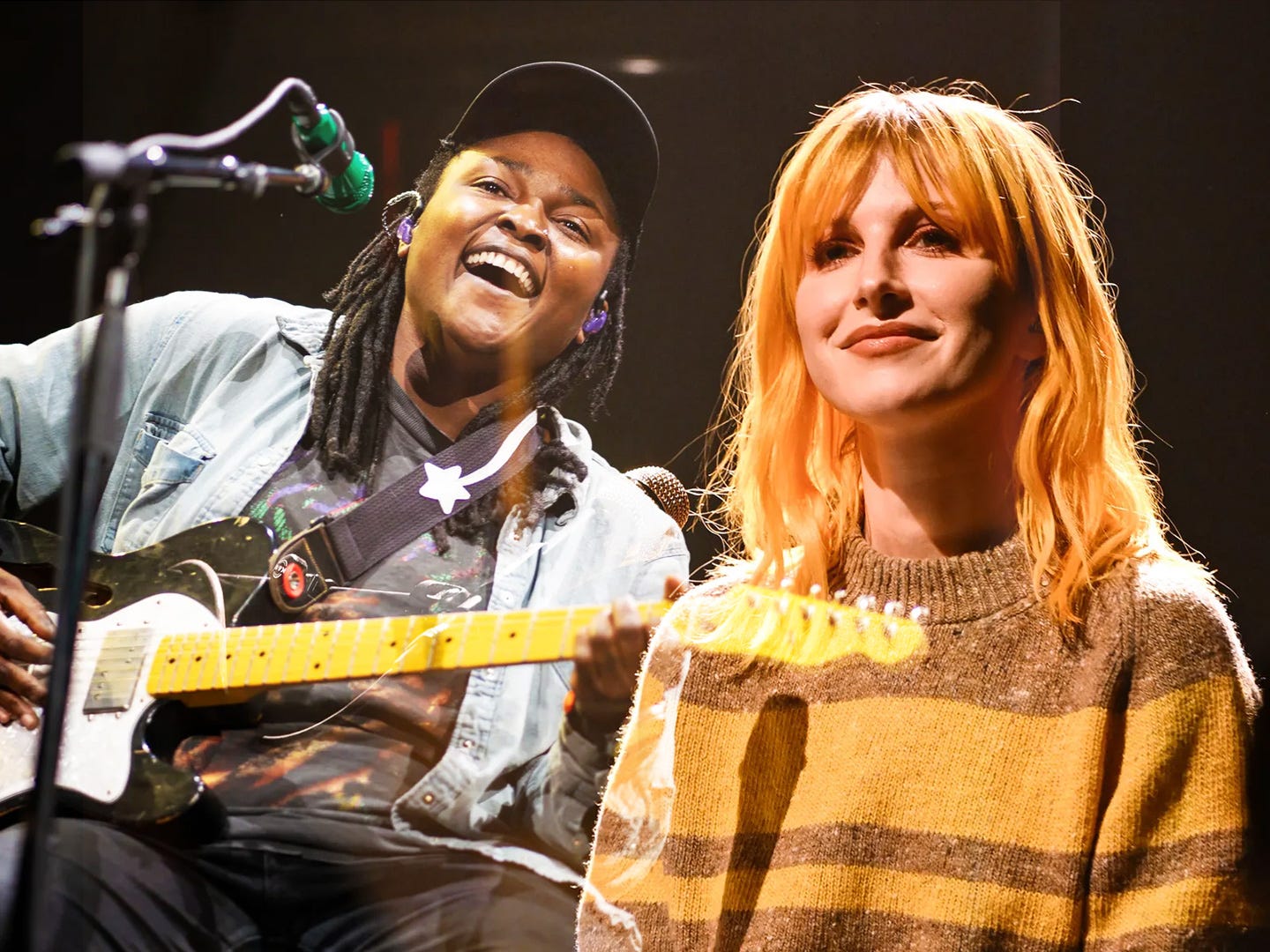
In early October, Hayley Williams sat beneath a gentle spotlight on stage at The Tonight Show Starring Jimmy Fallon. I didn’t catch it that night, but a few days later, I watched as the spellbinding singer, who is known for her Paramore fame, played piano while uttering the lyrics to “True Believer.”
The song from Williams’ latest solo album, Ego Death at a Bachelorette Party, is produced and written with the help of Daniel James, Jim-E Stack, and Eli Teplin. “True Believer” finds Williams reckoning with the places she calls home.
The performance is captivating for a number of reasons, but it felt especially timely less than a month after ABC suspended Jimmy Kimmel Live! following the host’s comments about Donald Trump and Charlie Kirk. Kimmel’s suspension was lifted prior to Williams’ performance, but late-night talk shows felt like they were under heightened scrutiny. Williams embraced it as an opportunity to speak truth to power.
Her decision to perform “True Believer,” an undeniably political song, flew in the face of Fallon’s wishes to stay apolitical—or as he put it, to “keep [his] head down and make sure the jokes are funny.” Williams got the last laugh. When the lights illuminate on stage, she is intentionally overshadowed by a mostly Black string ensemble while a sign hung from her piano reads, “Mississippi G-d Damn.”
The most striking line from the song is when Williams declares, “The South will not rise again ‘til it’s paid for every sin.” The Mississippi native moved to the Nashville suburb of Franklin when she was a teenager. She met her Paramore bandmates while in high school there and has since supported a variety of local causes, including the Love Rising benefit concert in 2023 that raised money for four LGBTQIA+ organizations based in Tennessee.
Among the artists who joined Williams on stage that night was Joy Oladokun, a fellow Nashville transplant whose latest project, Observations From a Crowded Room, was one of my favorite albums from last year. I imagine the concert was surreal for Oladokun, who recently reposted Williams’ Fallon performance on Threads and shared her admiration for the singer.
For Oladokun, a queer Black woman born and raised in rural Arizona, Williams represented someone who always used her voice as she stood alone in a male-dominated pop punk scene. Williams’ “True Believer” performance built on that record. “Growing up my parents would let me go to one concert a year with a friend,” wrote Oladokun. “Every time it was an option, I went to see Paramore. This is why.”
“I’ve been fortunate enough to meet and be disappointed by most of my heroes,” she continued. “Hayley Williams is the exception to that rule. Warm, wise, and just a good vibe.”
The same can be said for Oladokun, who I saw in concert earlier this year. She was humble but not self-deprecating, honest without oversharing, and fixated on care. One of my favorite songs she performed is “I’d Miss the Birds” where she contends with the same home as Williams in “True Believer.”
Both artists write about Nashville—its beauty and its shadows. They question what it means to love, and even stay, in a place where they and the people they care about may not belong. They cling to the pieces they can’t bear to let go but struggle to see the good in what’s left. A ruin of lifeless condos and honky tonk bars where white supremacists roam free.
I spent my middle and high school years southeast of Nashville in Charlotte, North Carolina. We moved there from Maryland after hearing your dollar could stretch further down South. I didn’t know anything about mortgage rates, but I know what it felt like the first time I saw a classmate wearing a Confederate flag t-shirt.
“It’s not hate,” he told our class. “It’s heritage.”
The mental gymnastics it takes to separate the two became even more elaborate as I enrolled in a predominantly white, private Christian high school. While I got to fulfill my dream of lettering as a varsity athlete, I had to become everything but myself to get there.
The pruning process began as early as my first week. For my U.S. history class, we were tasked with making a display of 10 notable Americans who were influential in our lives. Raised by Black women who made sure I knew my history, I shared about figures like Martin Luther King Jr., Malcolm X, Harriet Tubman, and Jackie Robinson. When I got to Barack Obama, the mood changed.
It was 2008, and Obama was facing John McCain to be President of the United States, which would make him the U.S.’s first Black president. As one of the only Black kids in my class, it was one thing to already be on the outside; it was another to be the Black kid who liked Obama.
Classmates would ask me if I wanted babies to be murdered. Teachers became more outspoken about their disdain for Obama, even going as far as praying against his election before class. After I stormed out the room one day, a teacher followed me into the bathroom and tried to assure me it wasn’t personal.
When it came time to make decisions about college, my high school’s guidance counselor was unrelenting in her push toward Christian colleges and universities—or as I saw it, a bigger version of our high school. While I decided to stay in North Carolina, I opted for a non-Christian liberal arts school two hours from Charlotte. Fear kept me active in the faith, but I later left behind their version of that, too.
While I loved my time in college, graduation took me away from North Carolina. I moved halfway across the country to Colorado Springs to begin my post-grad career. Escaping the South wasn’t my number-one priority, but it ended up being one of the most important things I could’ve done for me and my people.
Hundreds of miles away, I missed Elizabeth, who was still in school at the time. I missed my mom and sister, who had moved from Charlotte to Winston-Salem. I missed my homies and the late-night runs we’d make to Cookout. As I met other Southerners in Colorado, we’d reminisce about the drive-thru establishment where you can get a corndog as a side and 40+ milkshake flavors.
Despite everything I missed, I know I made the right decision to leave. Oladokun sings about the birds knowing when to fly away. Nowhere is perfect, but I love the way she puts it: “This world on fire still has good to discover.”
I think about the homes I’ve left behind. They were friends whose idea of care no longer aligned with mine. They were church pews where my friends could take a seat but weren’t allowed to be their full selves. They were ideologies that benefitted a few while the rest of the world was left to suffer.
Some of these homes gave me a sense of community. I met people who showed me a better world even when the one we were in didn’t look the same. I got glimpses of warmth from relationships that now feel distant. And even though North Carolina is where I nearly lost myself, I love going back and seeing some of the people who helped make me who I am.
“I’m the one who still loves your ghost,” sings Williams as the stage lights crash in. “I reanimate your bones with my belief ‘cause I’m a true believer.”
During an interview with NTS’s Flo Dill, Williams confesses, “I think something about really being from somewhere is that you love it like no one from anywhere else can, but you also can—and probably should—critique it like no one else can.”
This reminds me of a scene from The Last Black Man in San Francisco where the movie’s main character Jimmie Fails overhears two white women complaining about San Francisco on the bus. He speaks up and tells them they don’t get to hate the city where he’s from. When they couldn’t give a clear answer on if they love San Francisco, Fails says, “You don’t get to hate it unless you love it,” rendering them speechless.
Love is what brought Williams and Oladokun to Nashville; it’s what has kept them there, drawn them away at different times, and eventually led them to write their respective songs. Love is why I remember my upbringing with grief and nostalgia, demanding better from the places where I’ve been, and understanding, as Oladokun does, that love “doesn’t mean I should hang ‘round and suffer.”
It is loving to create separation when closeness will only hurt them and me. If my nearness to the people and places I previously called home only illuminates their flaws and the harm they’ve caused, it is better to stay away. The Ghosts of Lives Past still haunt me from time to time. But in Williams’ Fallon performance, I saw what I’m sure Oladokun did, too—and that’s that our love for a place, person, or belief system doesn’t mean we’re required to blindly follow. Sometimes, the most loving thing we can do is tell the truth.
Thank you!
I appreciate you reading! If you enjoyed, please share it with someone special.
Was this forwarded to you? Sign up here to receive my next newsletter directly in your inbox.
Support the newsletter: If you’d like to support my work, consider becoming a Paid subscriber to Feels Like Home or buying me a coffee.
Stay connected: For more content and updates, follow me on Substack, Instagram and Threads.
Thank you for writing this, and for talking about me and Joy’s songs like this. “I’d Miss The Birds” makes me cry.
I loved every word you wrote. Resonated to my core.
I enjoyed reading this and seeing how you connect your life experiences to music. I love true believer and I will have to check out Joy's song. Your comments about loving and hating your hometown made me think about how during the elections people often blame people in red states and are quick to critique it but people don't think about how so much activism and grass-roots efforts happen in the south. Like sometimes people fall under the fallacy of believing all people in an area are alike and all hope is lost, but people who live there know the good that exists there too 💛